YouTube Green
2025
Lowering Environmental Impact with Data Transparency

Responsibilities
Timeline
Problem
Most people who care about the environment have no idea that watching YouTube is part of their footprint.
That's not a knowledge problem. It's a design problem.
The data exists inside corporate sustainability reports that are dense, technical, and written for investors, not users.
The result is a gap between concern and action that no awareness campaign can close on its own.
Outcome
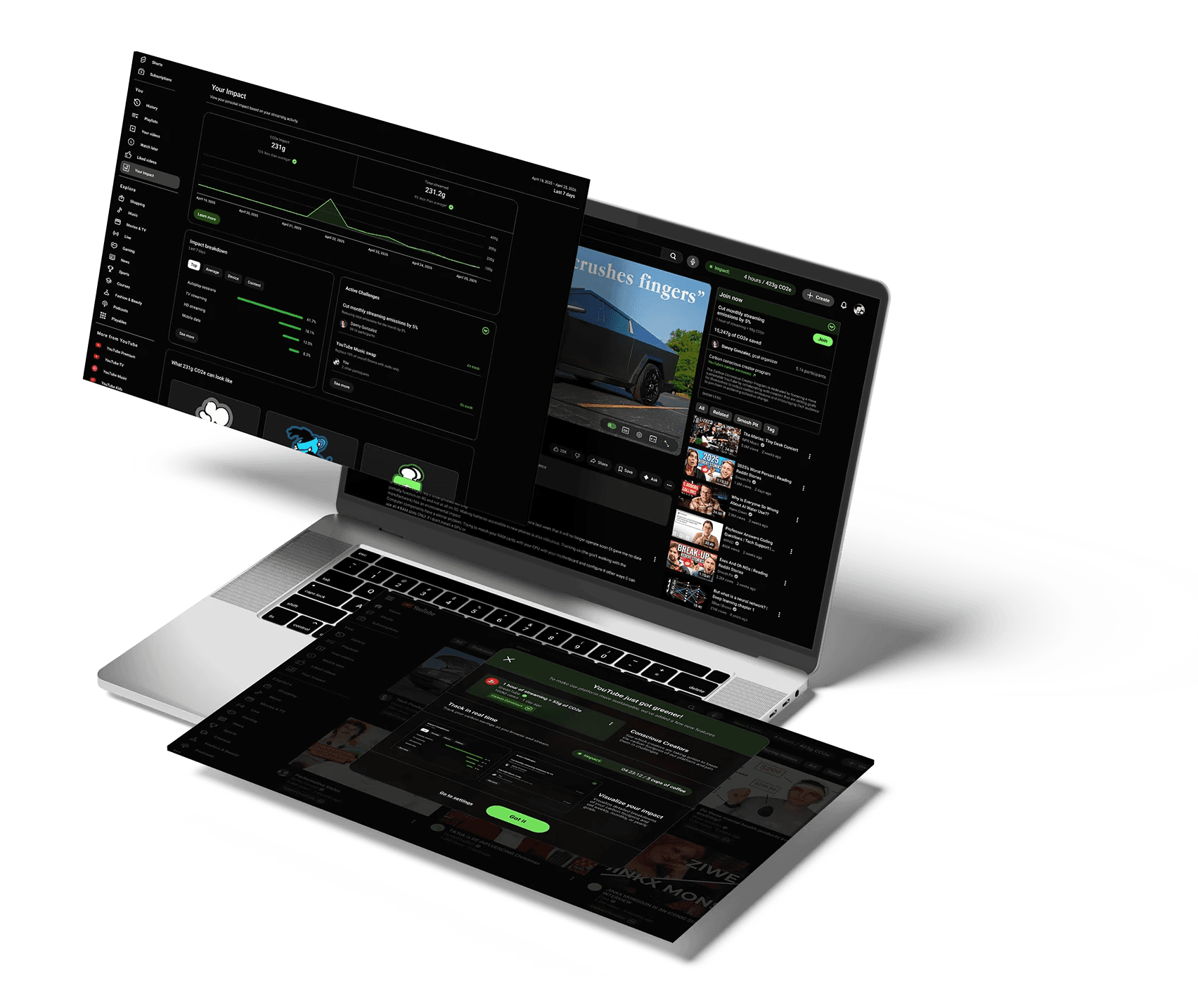
A suite of three features: a personal impact dashboard, a collective action system, and a live usage widget that together make environmental impact visible at the personal, community, and platform level.
When provided with the relevant data, 95% of users said they'd change their streaming habits once they knew which settings had the greatest impact.
Mission
Design transparency into YouTube's existing ecosystem so users can see, understand, and act on their streaming impact.
Process
01
Analyze the transparency gap in corporate sustainability reporting
02
Understand how users perceive and engage with their own environmental impact
02
Identify the overlap between user needs and platform opportunity to inform the solution
Discovery
Sustainability reporting isn't built to be read
Before designing anything, I needed to understand two things: why the data wasn't reaching users, and whether users actually wanted it to.
The Transparency Problem
Corporate sustainability reporting is not built for everyday people.
A Reuters study found fewer than 2% of major firms earn top marks for genuine climate disclosure, and the tech industry follows the same pattern.
Google's reported emissions show a roughly 54% variance from location-based calculations.
Microsoft's emissions grew ~25% since 2020 despite public climate pledges.
Netflix cites 26 million tons of CO₂ reductions based largely on unverified projections.
The pattern isn't always deliberate deception. It's structural opacity. Data that exists but can't be understood might as well not exist at all.
For users of any single platform, this means that they're making choices in the dark.
YouTube's Role
YouTube sits at a unique intersection of scale and user choice, but its users lack a fundamental understanding of their own contribution to that number.
Crucially, data on the impact of individual features that would provide this understanding is consistently opaque.
Define
Users care. They just have nothing to act on.
To test whether this was a real user problem and not just a systemic one, I surveyed 40+ YouTube users on their awareness, willingness, and perception of the platform's environmental impact.
Awareness
felt YouTube was non-transparent about its environmental impact.
knew that autoplay affects energy use, only 27% knew device type was a factor.
had no awareness of streaming's carbon footprint at all. Another 41% were only somewhat aware.
Willingness
believed environmental responsibility belonged equally to the platform and its users.
expressed concern about the environmental impact of their digital habits.
Perception
Sharing early concepts mid-survey revealed something unexpected. Users hadn't been explicitly asked whether the features were useful, yet their perception of YouTube shifted noticeably.
Even just the proposal of features that would increase transparency was enough to improve how users felt about the platform by 40%.
Before ——>
After ——>
The gap isn't apathy, it's access.
Not one respondent placed responsibility solely on users, indicating that users aren't disengaged from sustainability. They're just disconnected from the information that would make engagement possible.
When that information is surfaced in a relevant, accessible way, willingness to act follows almost immediately.
Awareness itself incites the desire for action.
How might YouTube align its feature ecosystem with a sustainable future by empowering user choice?
Ideation
Not every good idea is the right idea
Research identified what users needed. The prioritization grid determined what was actually feasible to design within the scope of YouTube's existing ecosystem.
Grounding in YouTube's Design System
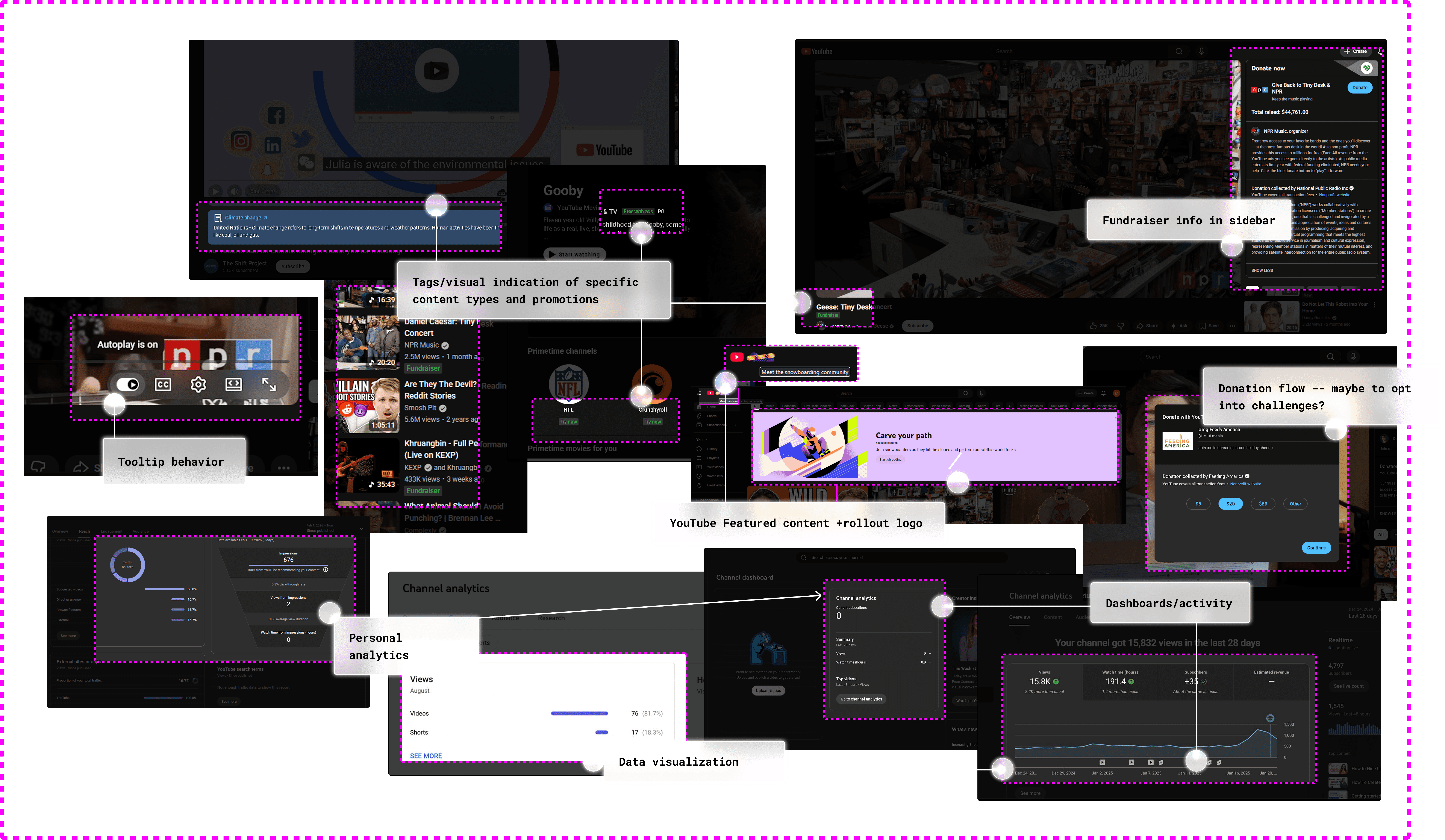
Before sketching anything new, I audited YouTube's existing UI for patterns I could build on — data visualization treatments, notification formats, and promotional content placements.
Designing within the established system ensured that solutions would feel native to users rather than disruptive, and gave me a realistic sense of what kinds of interventions were viable.

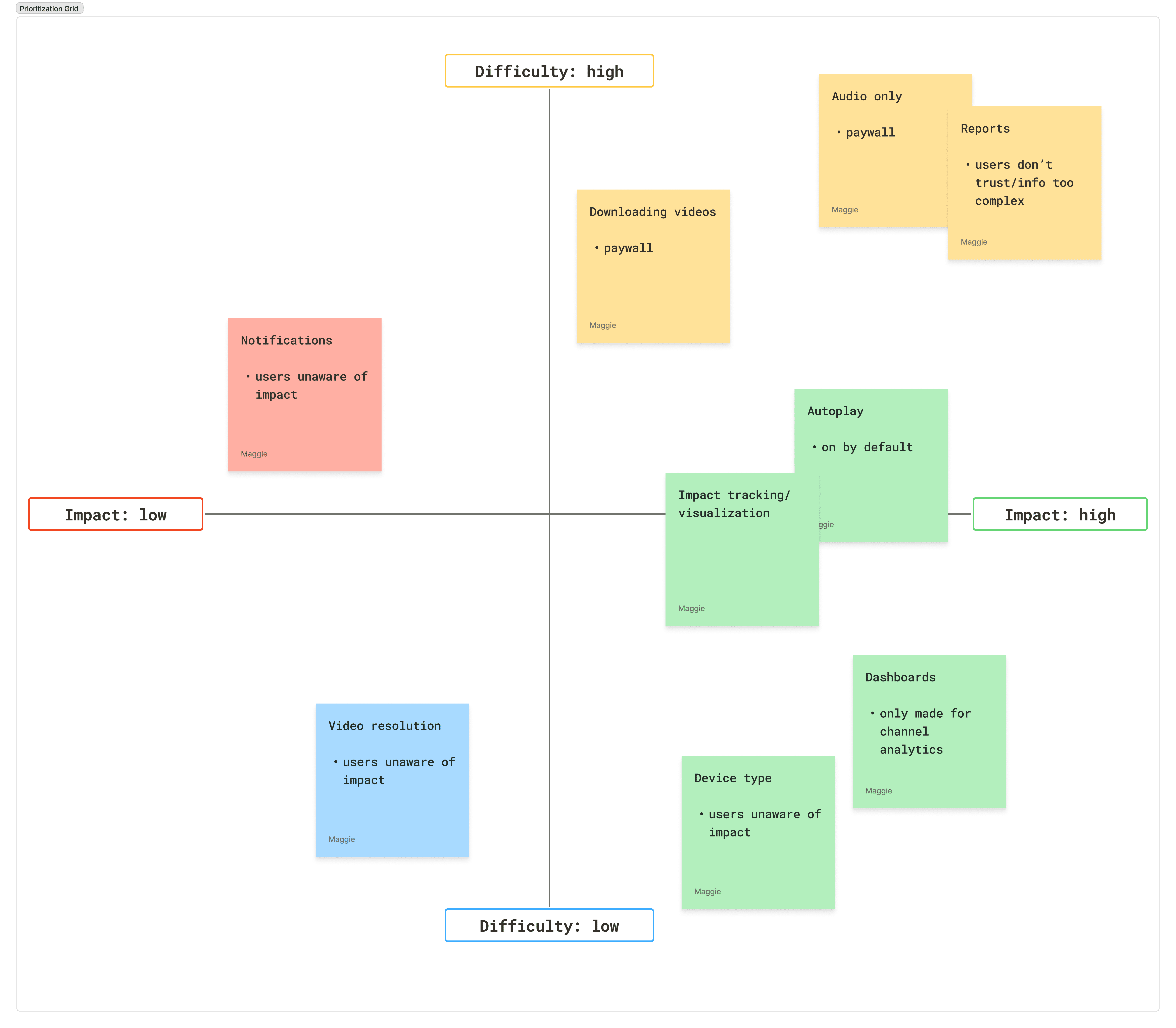
Prioritizing by Impact and Feasibility
I mapped potential features against the impact it would have on user awareness and resulting behavior, and the difficulty or risk it would represent from YouTube's perspective as a business.
Features that required paywalled access or significant infrastructure changes were noted but deprioritized.
Design
Three features. One system.
Users didn't need to be convinced to care. They needed a system that made caring possible.
YouTube Green introduces three features that work together to make environmental impact visible at the personal, community, and platform level.
01: Usage dashboard
Without personal, contextualized data, concern stays abstract.
Users expressed concern about their streaming footprint but had no reference point for what their habits actually cost.
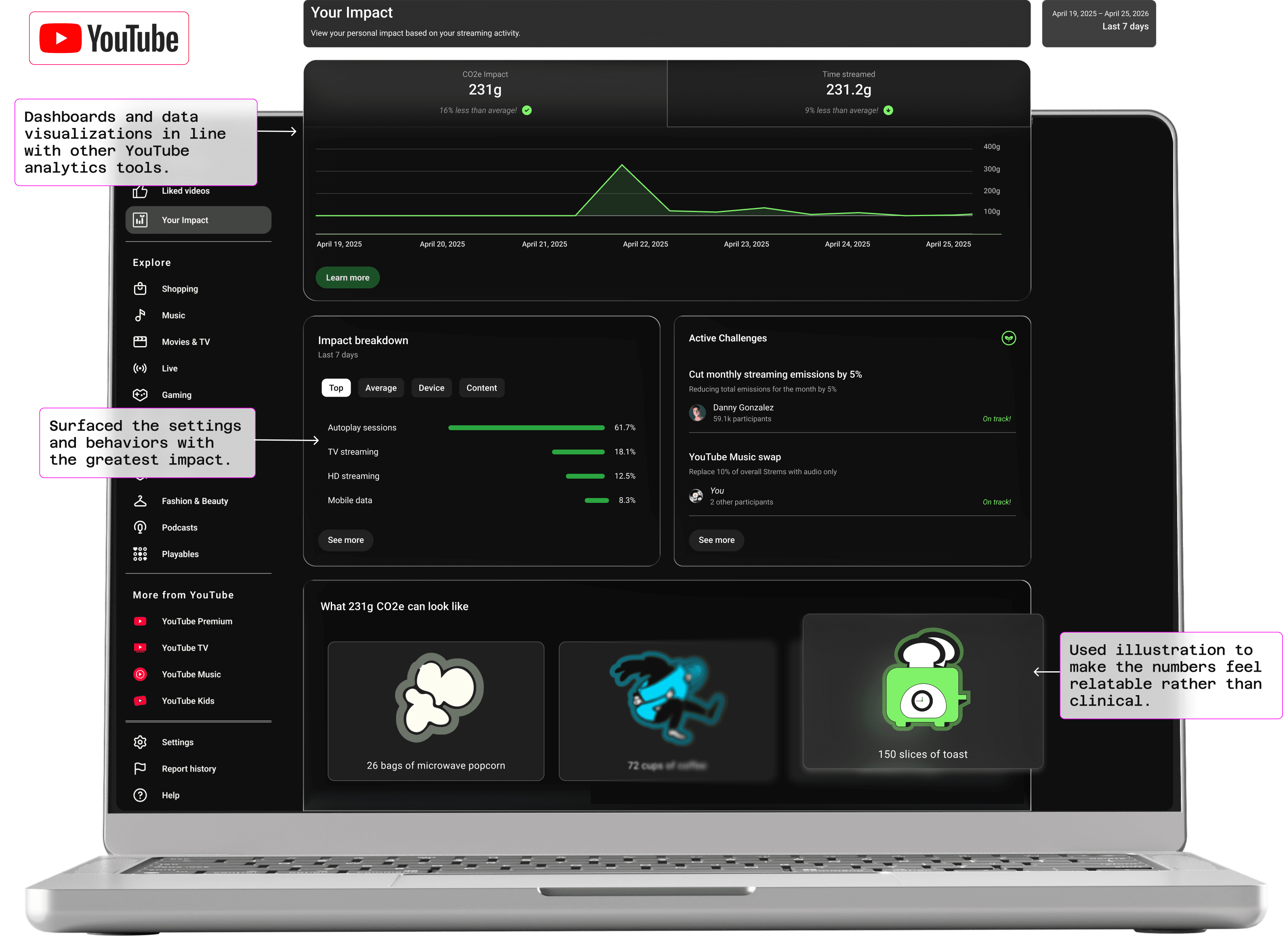
Individual usage analytics translate streaming activity into understandable environmental impact. Rather than raw emissions data, the dashboard surfaces which behaviors matter most and frames them in relatable contexts.
of respondents were at least somewhat interested in a personal streaming dashboard. Only one person out of 44 said otherwise

Early exploration
Early iterations organized content around user goals, which unintentionally shifted focus toward individual achievement rather than collective impact.
The final design reduces cognitive load and keeps the framing grounded in environmental context rather than personal performance.

02: Concsious Creators
Users didn't just want information. They wanted to see that their actions mattered.
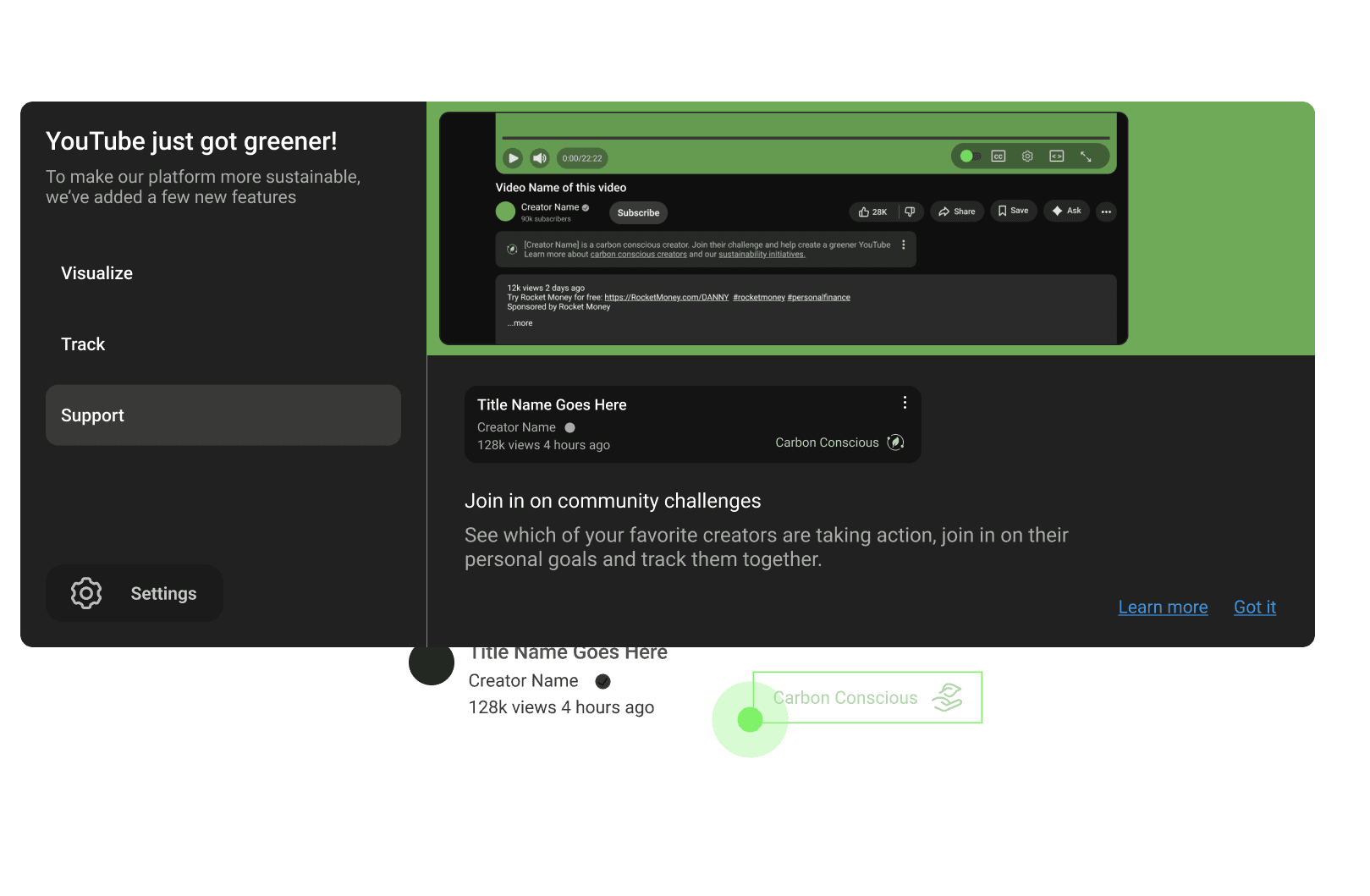
The Conscious Creators initiative partners with creators on activity-based challenges, using community support to drive greater impact and connect individual actions to a collective result.
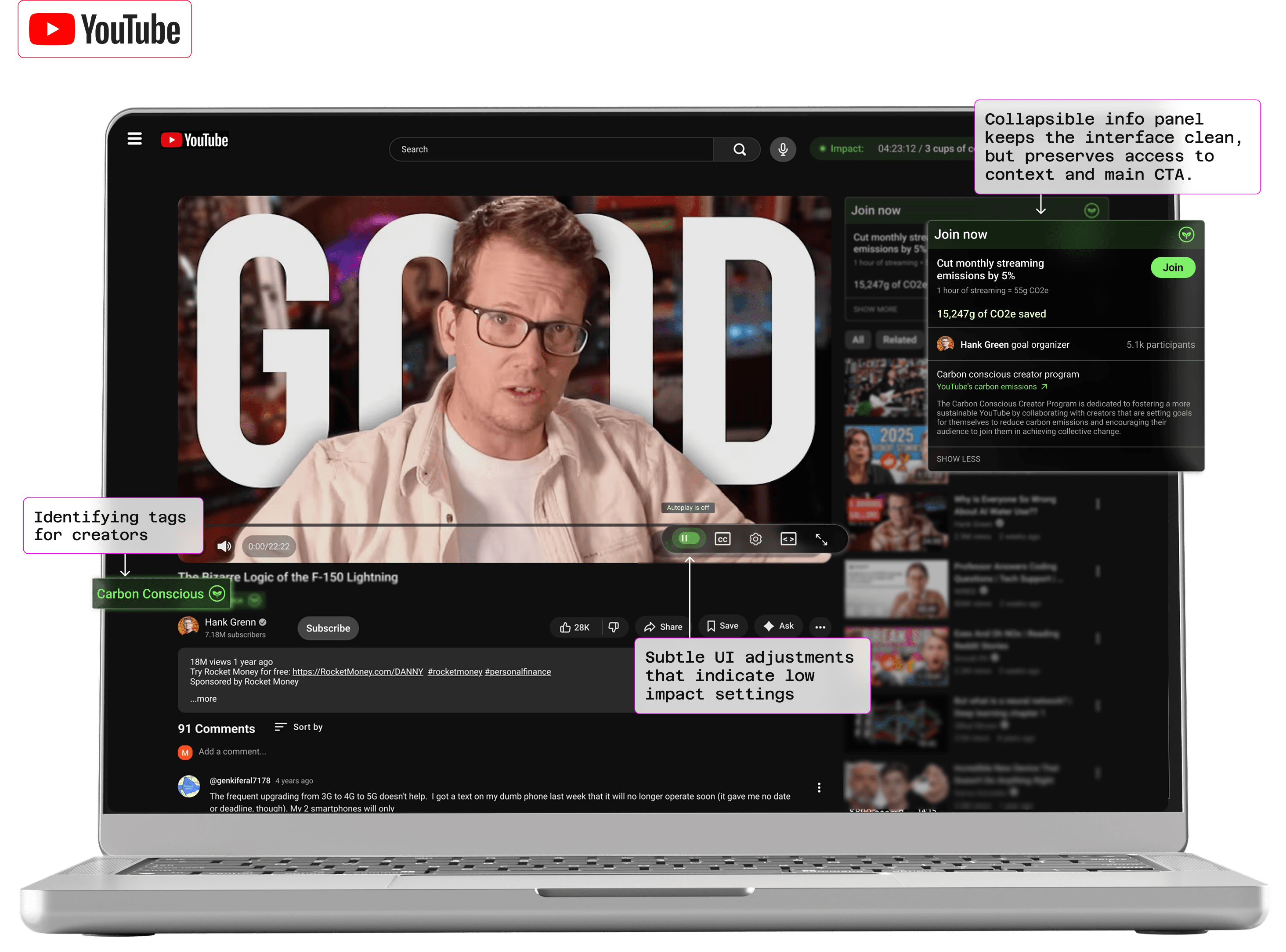
YouTube's participatory culture and users' shared sense of responsibility signaled an opportunity for collaborative solutions rather than individual behavior alone.
of respondents felt users alone should bear responsibility for reducing streaming's impact.
said they'd consider participating in creator-led sustainability challenges

Early exploration
The first iteration was a banner underneath the video, but it required navigating off the page for necessary context.
The final version surfaces impact and context immediately, removing the friction between awareness and action.

03: Live Usage Widget
Mindless streaming thrives on invisibility.
Users wanted sustainability considerations woven into their normal browsing experience, not siloed into a separate section of the app.
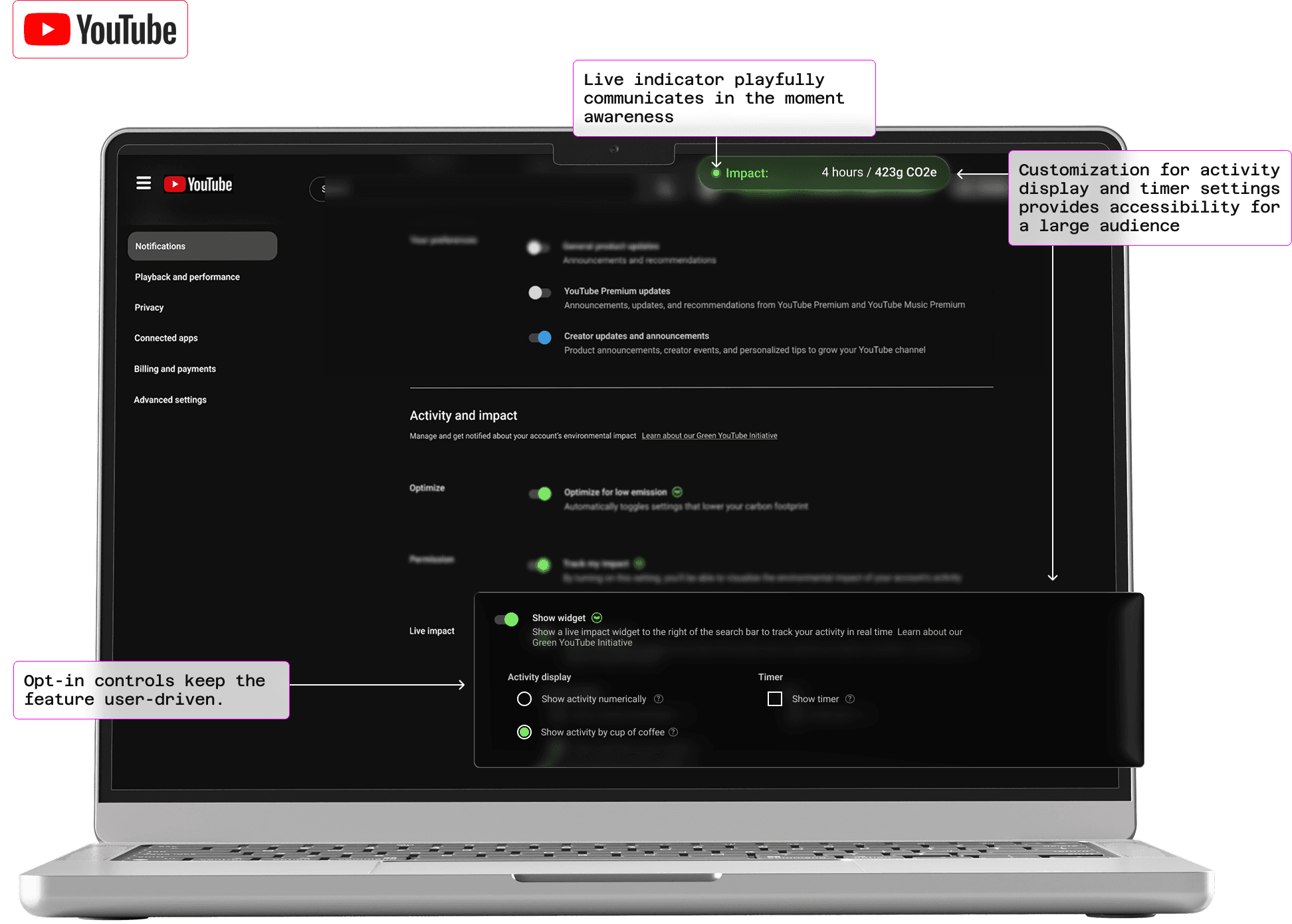
A customizable nav bar widget keeps streaming impact visible throughout the platform, discouraging mindless usage. Subtle icons, tooltips, and color changes surface the environmental cost of individual settings inline — no navigation required.
of respondents selected icons and tooltips as their most wanted feature type

Early exploration
First iterations used a single display format, but the lack of flexibility resulted in a lack of relatability.
The same number means more to different people in different formats, so the final design lets users choose the translation that makes the most sense to them — raw CO₂e, or a familiar equivalent like cups of coffee.


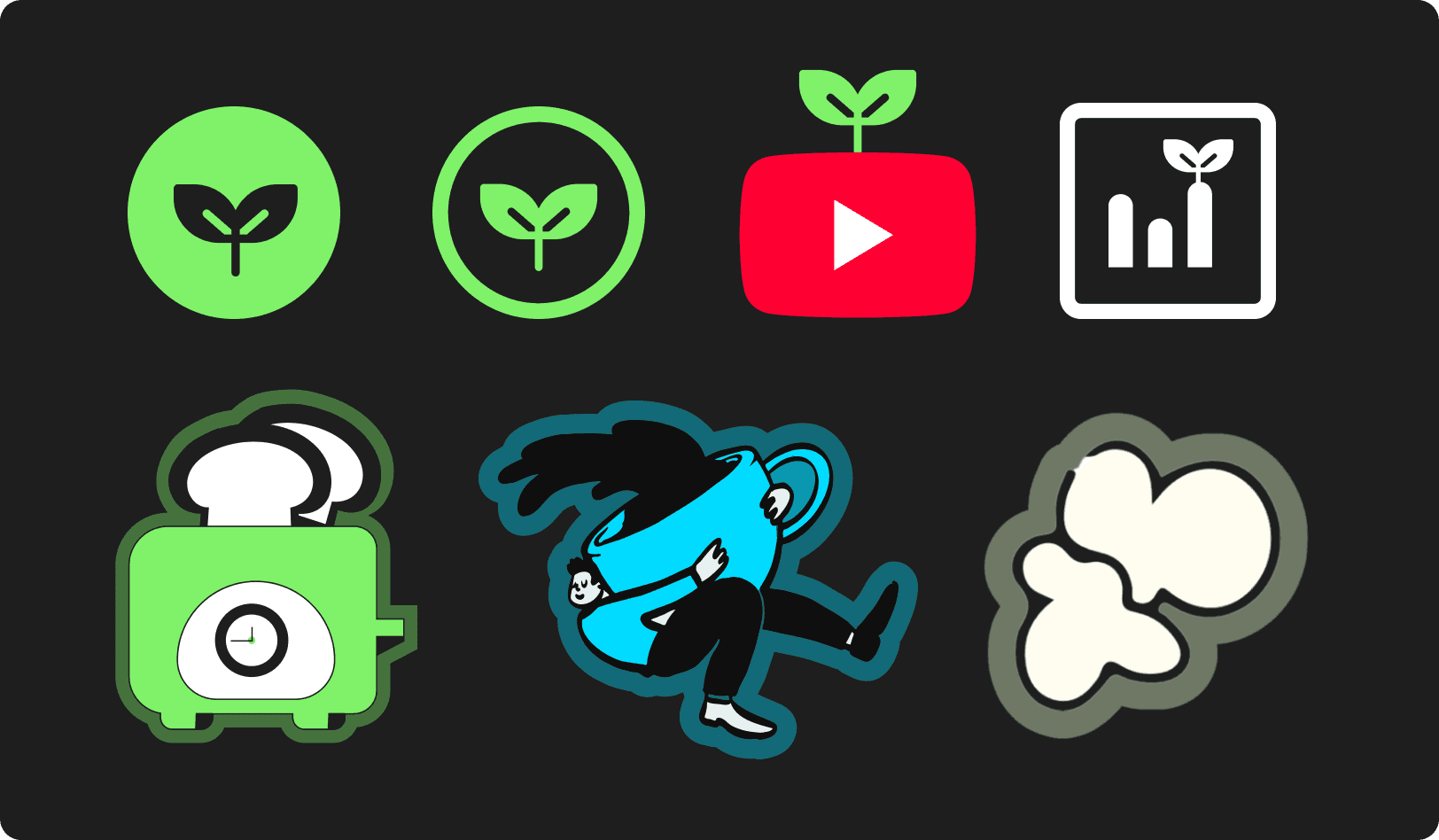
Icons and illustrations

04: Rollout Onboarding
A feature no one reads is a feature that doesn't exist.
New functionality only creates impact if users actually engage with it. Introducing three new features at once risked overwhelming users or going entirely unnoticed.
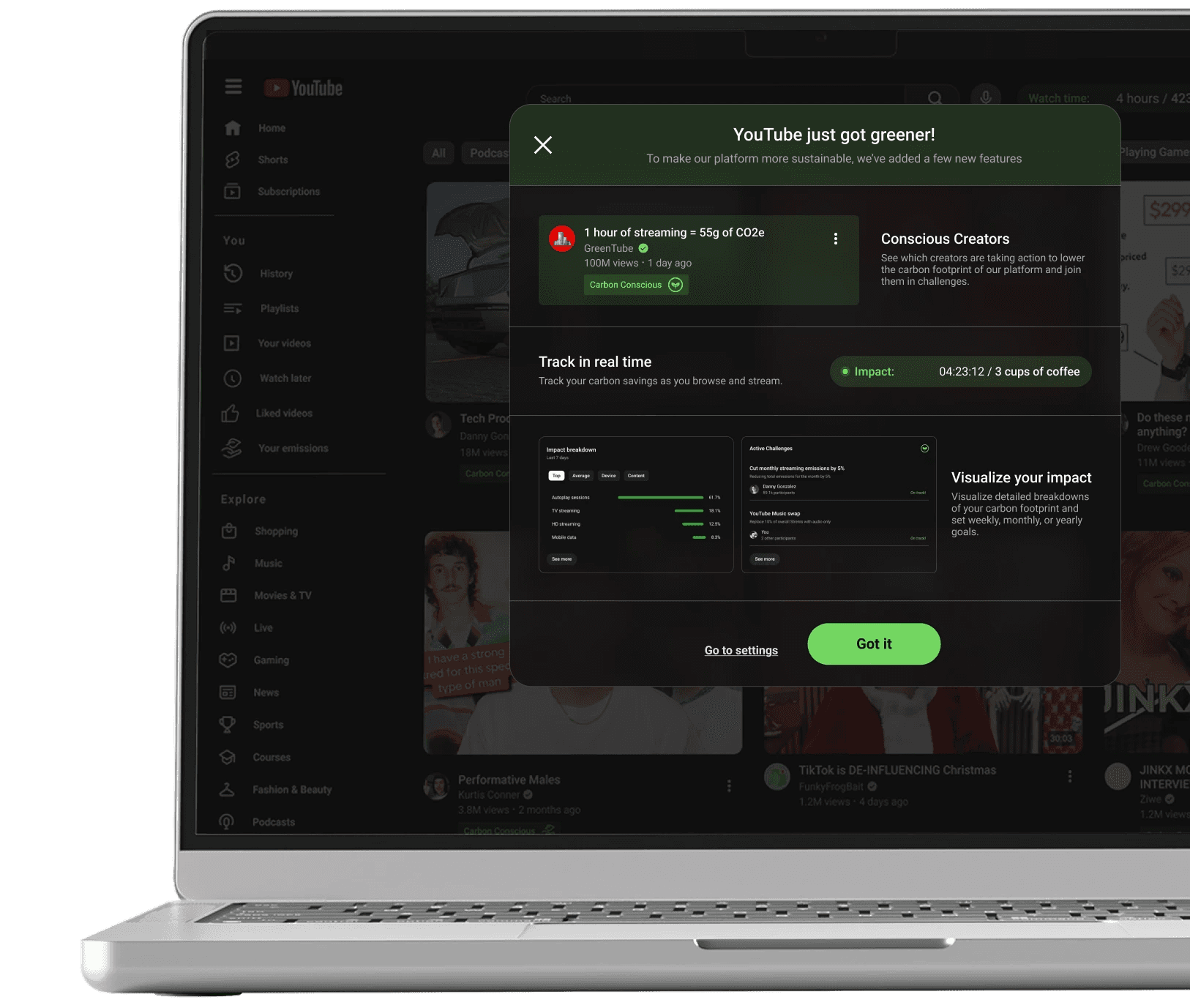
A first-visit popup introduces all three features in a single, scannable moment. The zigzag layout surfaces the dashboard, Conscious Creators, and the live widget in one pass with just enough context to orient users before they click away.

Early exploration
An earlier version used a tabbed layout with panels for each feature. Feedback during a demo revealed that the additional clicks created enough friction that users were likely to dismiss it without reading.
The final version removes that decision entirely. Everything visible, nothing buried.

Reflection
What the data already points to
This was a school project, so there weren't results to measure at a production level. But the survey already signals where success would land: in recovered trust, changed behavior, and the passive features users said they wanted most.
The next step is usability testing to validate the decisions made on instinct, and building out flows for the app to address where most streaming actually happens.
Outcome
92%
improvement in ratings from previously dissatisfied users.
95%
intent to change platform settings upon seeing the visualized impact
70%
average motivation in users to adopt more sustainable digital habits.
Next steps
01
User testing and design iteration
Evaluate engagement and track retention rate.
02
Adapt new features for the mobile app
reach a broader audience and maintain platform consistency.
03
Build out flows for the Conscious Creator initiative
Explore the challenges, feature design, and reception
04
Explore high-risk, high-impact features
Radio mode and accessible downloading were deprioritized for feasibility but warrant deeper research.