works
playground
Available to work
Designer by day
…..and Designer by night
works
Greener
2025
Comparing products across cost, nutrition, and sustainability.

Responsibilities
UX/UI
UX research
Prototyping
Tools
Figma
Cursor
Timeline
3 weeks
Problem
Sustainability and nutrition are perceived as expensive, time-consuming, and overwhelming.
Most people who want to do better don't know where to start, and the tools that exist make them feel worse for trying.
Outcome
A mobile app that helps users make small, budget-conscious swaps in their grocery choices, showing the compounded impact of those swaps over time without pressure, guilt, or the need to be perfect.
72% of surveyed users said they'd want a tool like this. 85% said personalized product suggestions would be the most valuable feature it could have.
Mission
Give people a way to do just a little better within their real circumstances, and make that feel like enough.
Process
01
Identify the core barriers to sustainable nutrition and their root causes
02
Validate the problem through surveys and expert interviews
02
Design a feature set that meets users where they are, not where they think they should be
Discovery
The problem isn't what people eat. It's how the conversation is framed.
My first phase of research started broad — academic literature on barriers to sustainable nutrition — before narrowing into direct user research. Three recurring themes emerged across every source.
01 Cost
There's a deeply embedded perception that "good" choices are inherently expensive. Greenwashing and consumer culture have reinforced the idea that expensive equals better, making budget-conscious users feel excluded from sustainability before they even start.
02 Time
Taking the time to research your options, especially when you already believe it's going to cost more, is just as overwhelming as the problem itself. The effort required to make a sustainable choice often exceeds the perceived benefit.
03 Guilt
The way sustainability is communicated carries an association with drastic change, sacrifice, and failure. That framing doesn't motivate people — it shuts them down. Expert interviews surfaced this consistently: guilt tripping has a boomerang effect, producing no change or actively negative outcomes.
"Consider the lens of 'OK, you failed — now what?' Maybe the target audience is people who feel ashamed and don't know how to come back." — Dr. Rebekah Fox, Organization and Environmental Rhetoric
—Expert interview
Organization and Environmental Rhetoric
"Sustainability is a need proven by science. The public dispute is all about communication." —
—Expert interview
Organization and Environmental Rhetoric
These weren't just academic observations. They became the foundation for every design decision that followed.
Define
Most people are already trying. The tools keep setting them up to fail.
To validate the problem at a user level, I ran two surveys across 92 total respondents, alongside four in-depth expert interviews with academics, nutritionists, and community sustainability organizations.
Awareness and attitude
55%
of respondents said they think about sustainability sometimes and act when there's an obvious opportunity.
nearly 90%
think about it at least occasionally.
The desire to engage exists. But desire without accessible tools stays abstract.
75%
listed price as the single biggest factor in their food choices.
and 44%
said convenience shapes their diet more than anything else.
Emotional load
91.5%
of respondents reported feeling some level of guilt, shame, or judgment about their food choices in the context of sustainability. Only 8.5% felt none.
78.7%
said a stressful day or low mood often or very often disrupts their eating habits.
Emotional state is a primary driver of food behavior, and few existing app accounts for it.
Perception of sacrifice
83%
agreed that sustainable eating is expensive.
and 68%
agreed it requires sacrificing time and convenience.
The perception of sacrifice is real. The sacrifice itself isn't always.. The sacrifice itself isn't always. 51% thought sustainability meant giving up comfort foods, while a near-equal group disagreed.
Existing solutions
The market has been trying to solve this problem. It keeps losing people for the same reasons. 40% of users who had previously used a nutrition app stopped due to loss of interest or relevance.
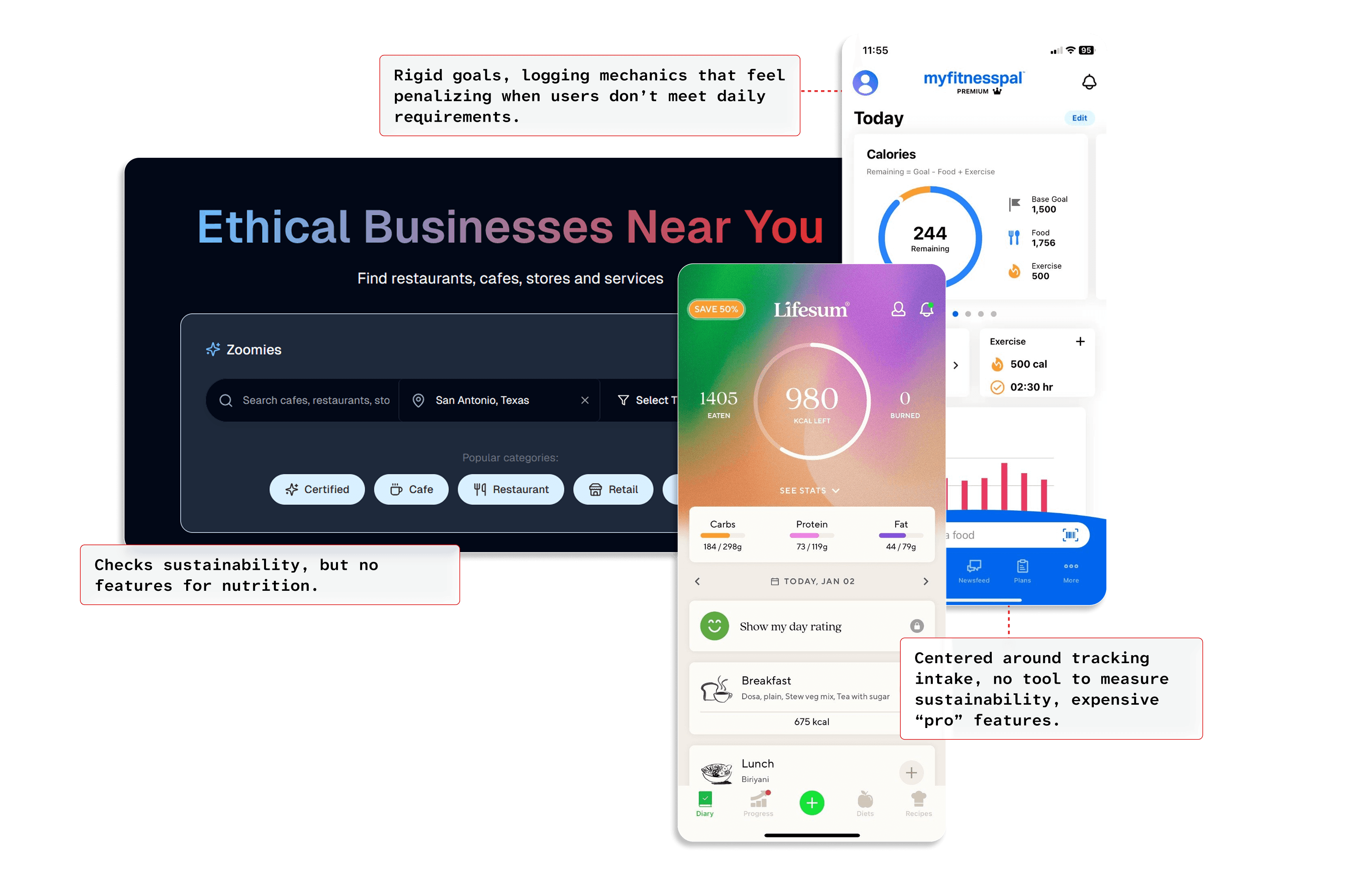
The problem isn't that people don't care. It's that caring feels impossible within the constraints of their actual lives. Every tool designed to help them has added more tracking, more judgment, and more opportunity to fail.

Sam, 26
"Too busy for change"
Austin, TX
Full-time student + full-time job
Health-conscious, eco-aware, perpetually stretched thin
Goals & Motivations
Cook more without spending more
Find sustainable options that fit his budget
Make better choices in the moment without extra mental labor
Feel like small efforts are actually adding up
Frustrations & Pain Points
Sustainable options feel inaccessible and expensive by default
Guilt when convenience wins (which is often)
Juggling multiple apps that each only solve part of the problem
Generic tips that don't account for his budget or schedule
No way to compare options quickly when he's already at the store
"I know I should eat better and be more conscious about it. But by the time I'm done with everything, I just grab whatever's there. I don't have the time or energy to figure out what the 'right' choice even is."
All 32 HMW's
People already want to do good. They just need tools that make it easy within their real lives.
How might we help users make small, meaningful improvements without adding to their cognitive load?
Ideation
Every existing app solves half the problem.
Competitive landscape
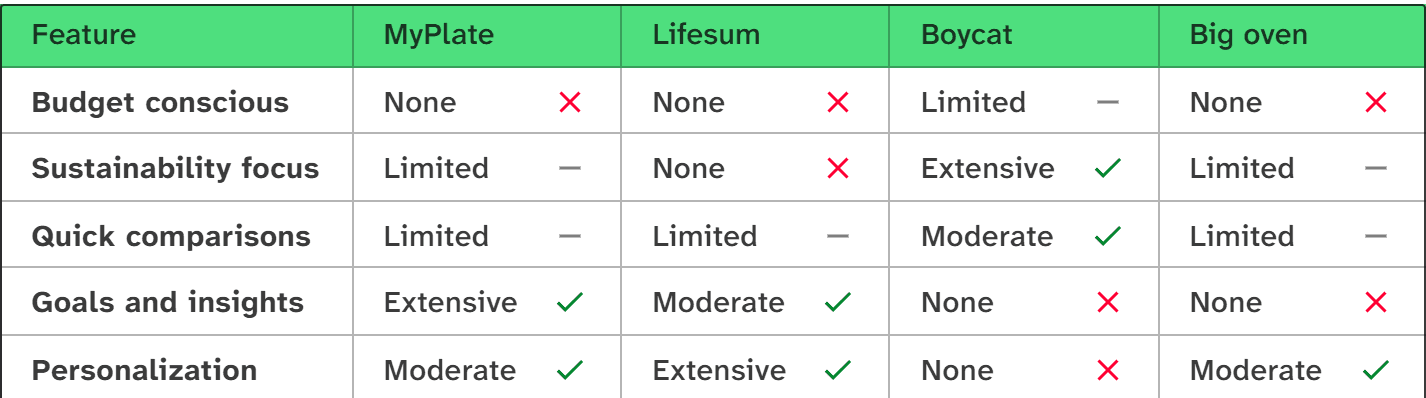
I analyzed four existing apps — MyPlate, Lifesum, Boycat, and Big Oven — across five dimensions: budget consciousness, sustainability focus, quick comparisons, goals and insights, and personalization.
The gap was clear. Every app optimized for one dimension. None combined sustainability and nutrition while accounting for cost. Users who want the full picture are currently juggling multiple apps — which is exactly the kind of extra effort they've explicitly said they don't have.

The gap was clear. Every app optimized for one dimension. None combined sustainability and nutrition while accounting for cost.
Users who want the full picture are currently juggling multiple apps — which is exactly the kind of extra effort they've explicitly said they don't have.
Prioritization
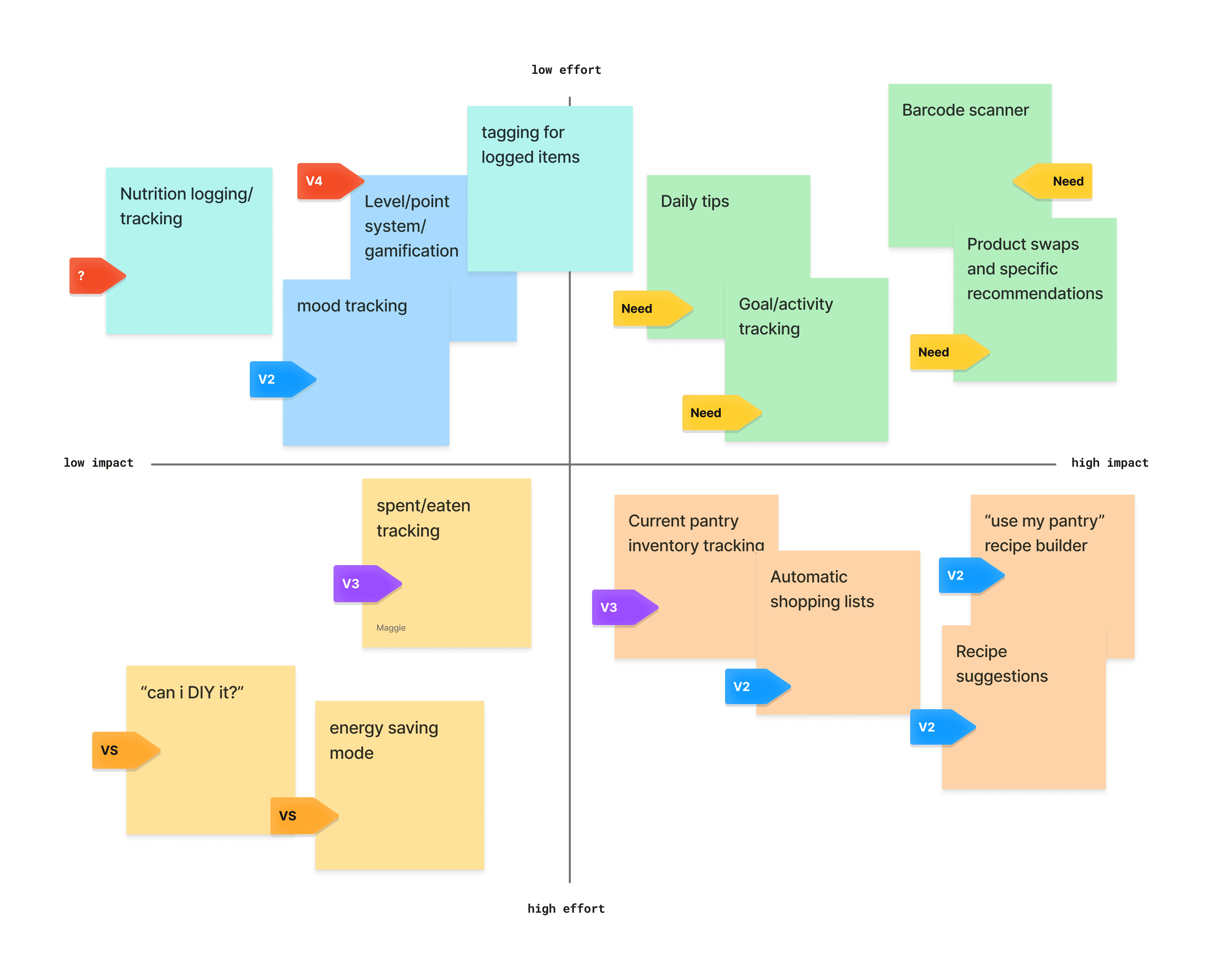
With a range of possible features mapped out, I plotted each against two axes: user impact and implementation effort, organized into release batches to give myself clear reference points within the timeline.

The MVP priority: personalized swaps and barcode scanning. High impact, achievable within scope.
Features like personalized recipes, pantry inventory, and community tools were scoped to V2 and V3 — valuable, but not essential to validating the core concept first.
Design philosophy
Three principles shaped every design decision:
Clear data visualization that communicates what users need without friction.
Adaptive suggestions based on lifestyle, preferences, and budgets.
Features that adapt to real life circumstances without requiring perfection.
Design
Four features. One rule: no guilt.
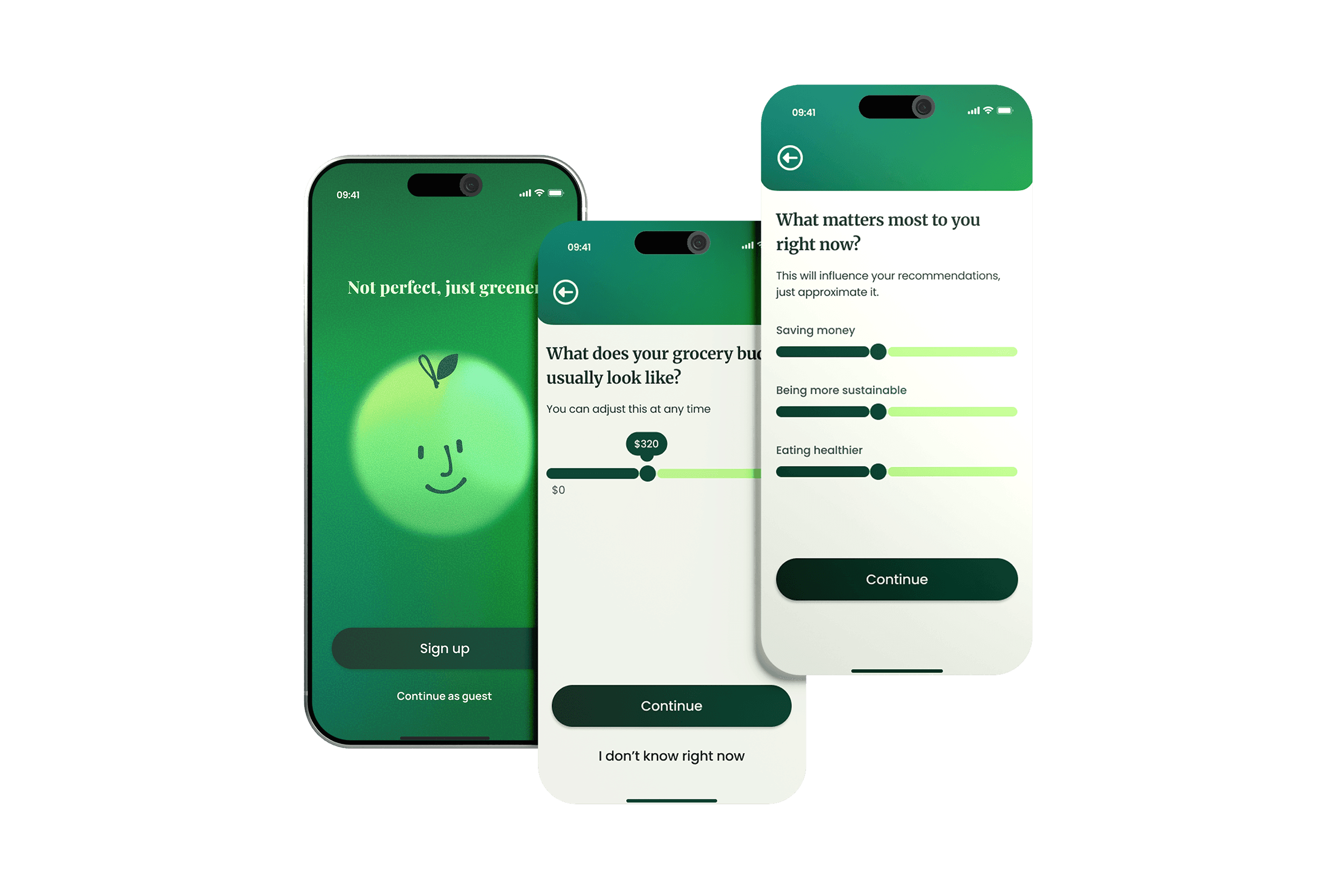
Users completed an onboarding quiz collecting dietary preferences, monthly budget, and sustainability goals. This powers the personalization engine and ensures every recommendation is grounded in the user's actual circumstances from the first session.
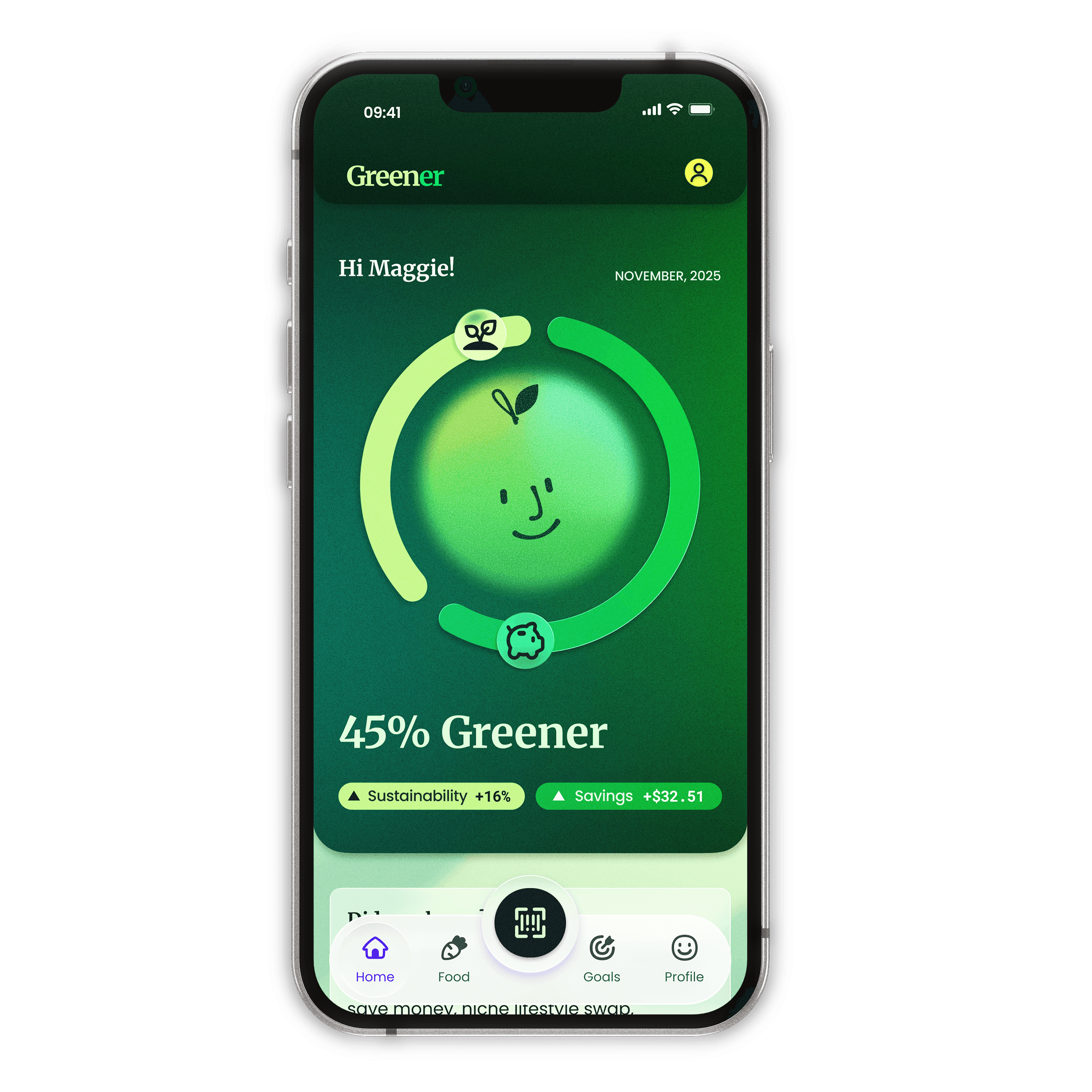
01: Personalized overview
Progress feels pointless if you can't see it.
Users need evidence that small choices were adding up — not as a performance score, but as visible momentum over time.
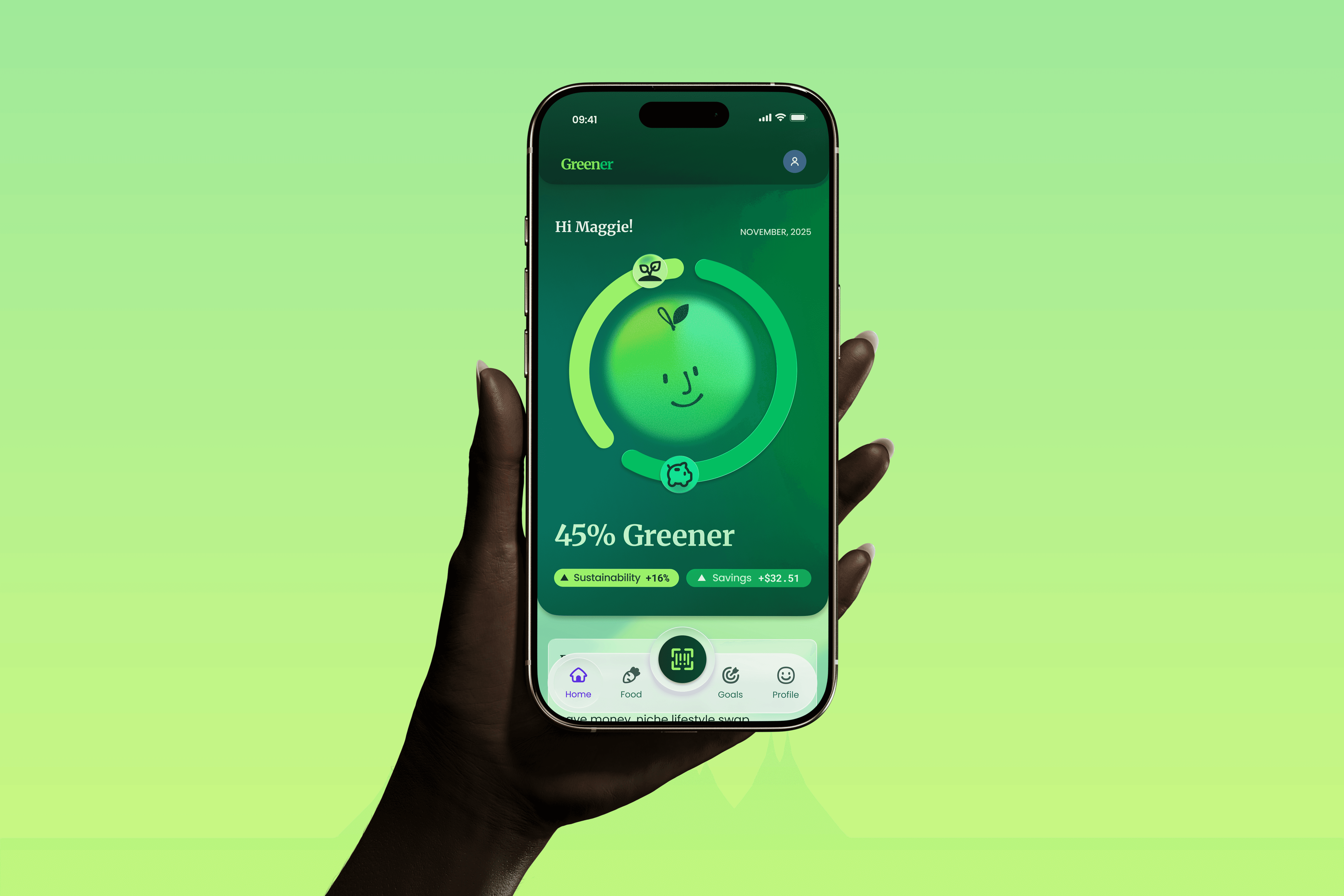
The homepage frames every choice as movement toward being Greener. Any swap improves your baseline. There's no floor to fail through.
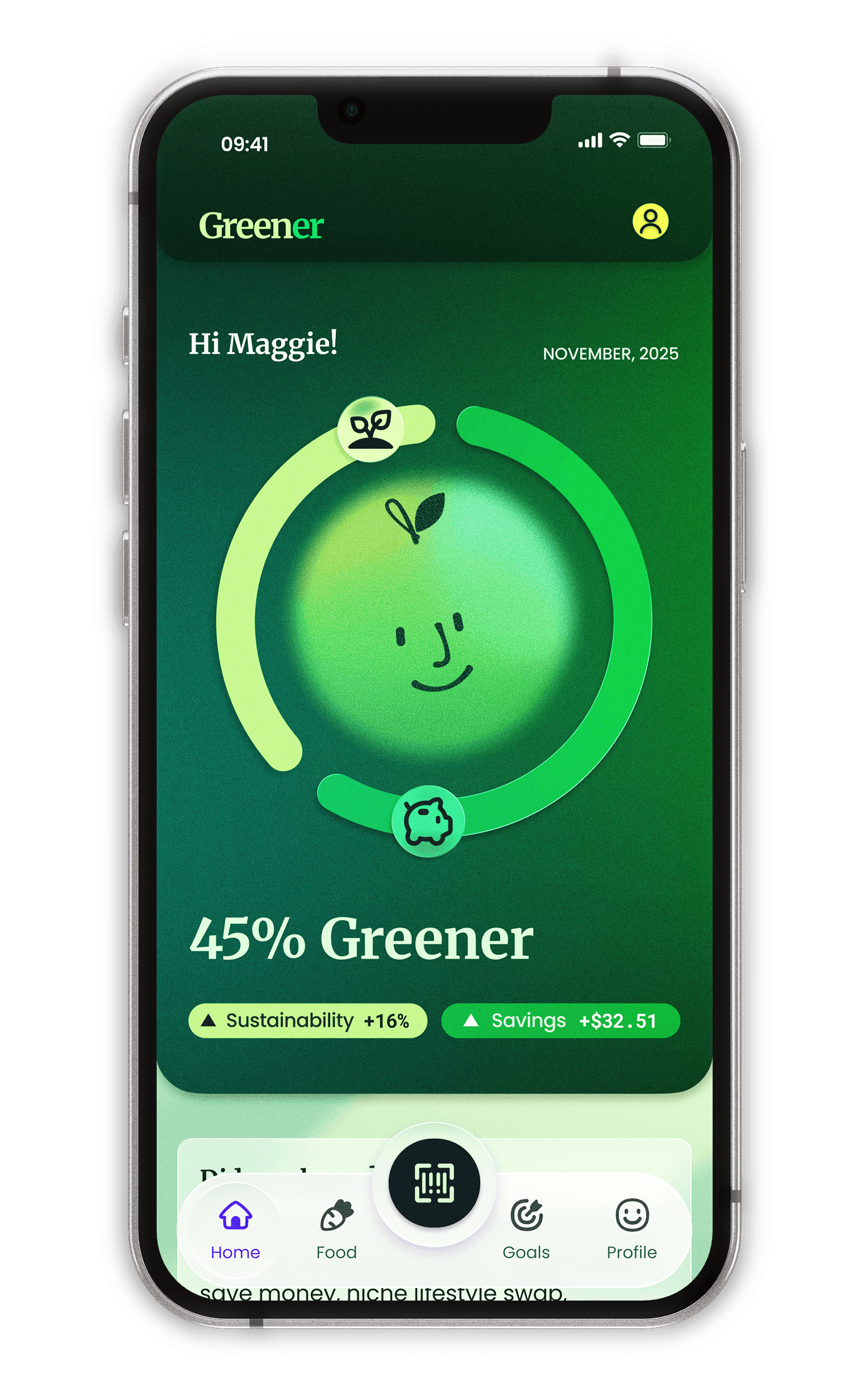
76.6%
selected insight visualization as a feature they'd want — the second-most requested feature in the survey.

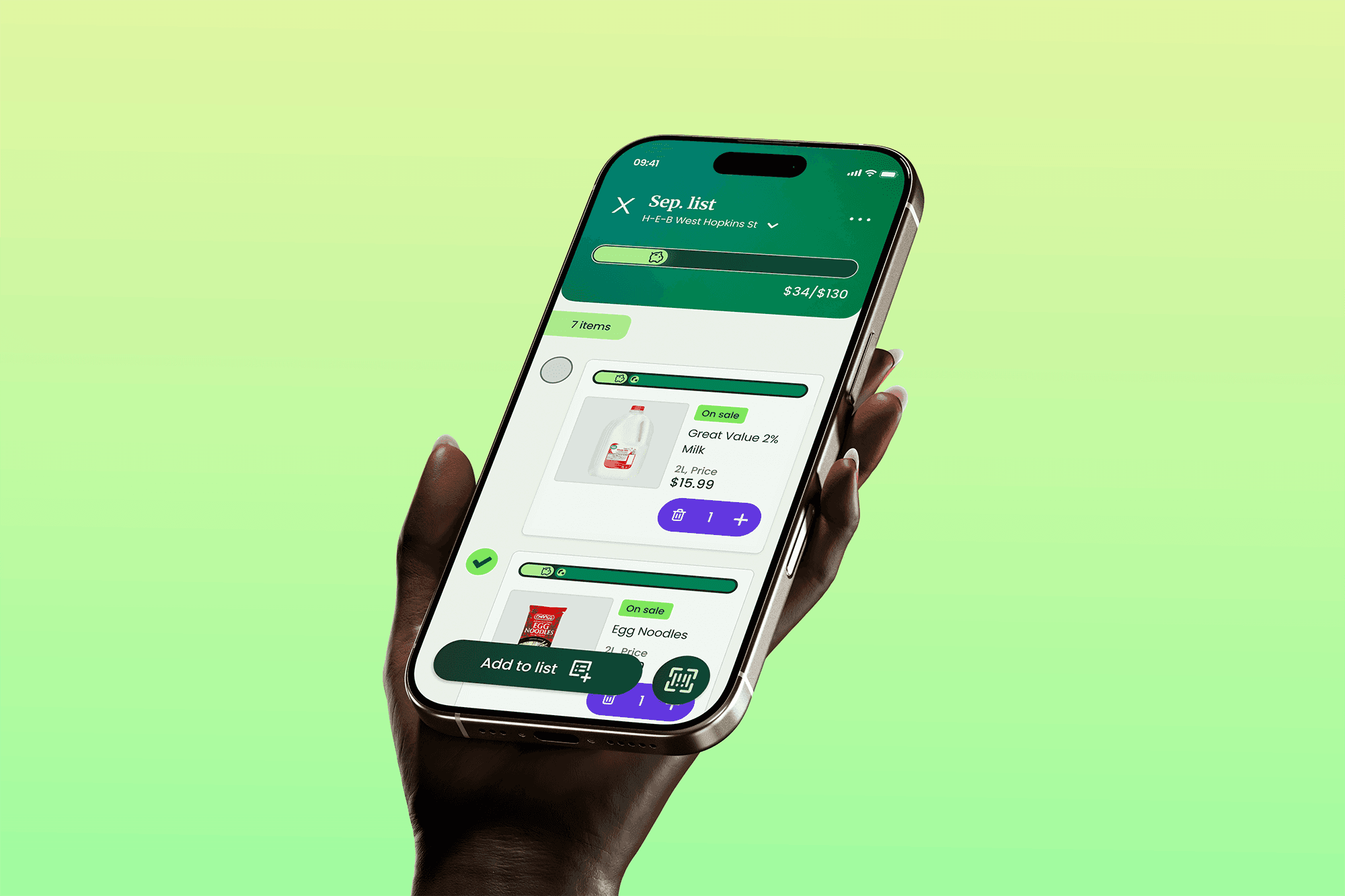
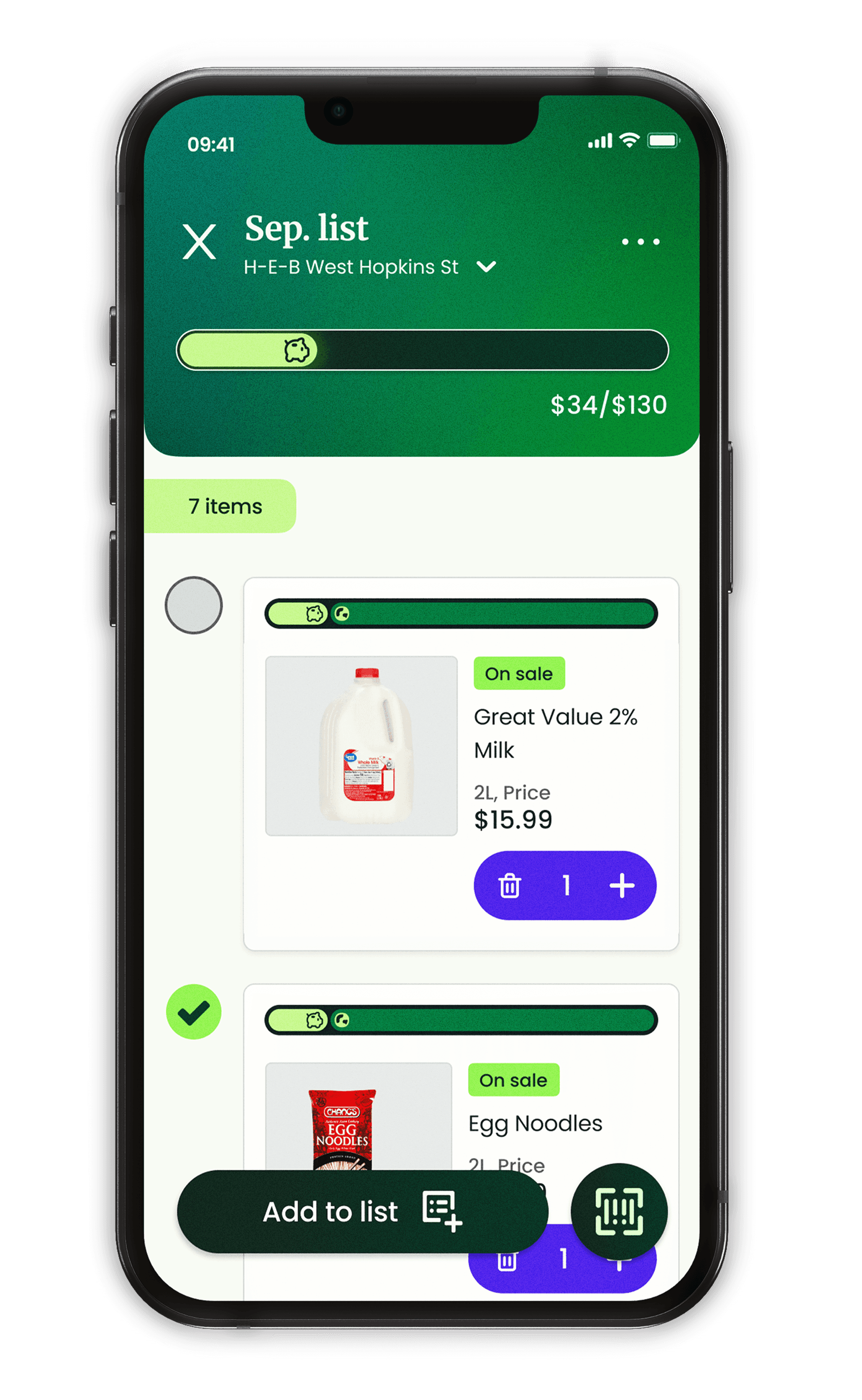
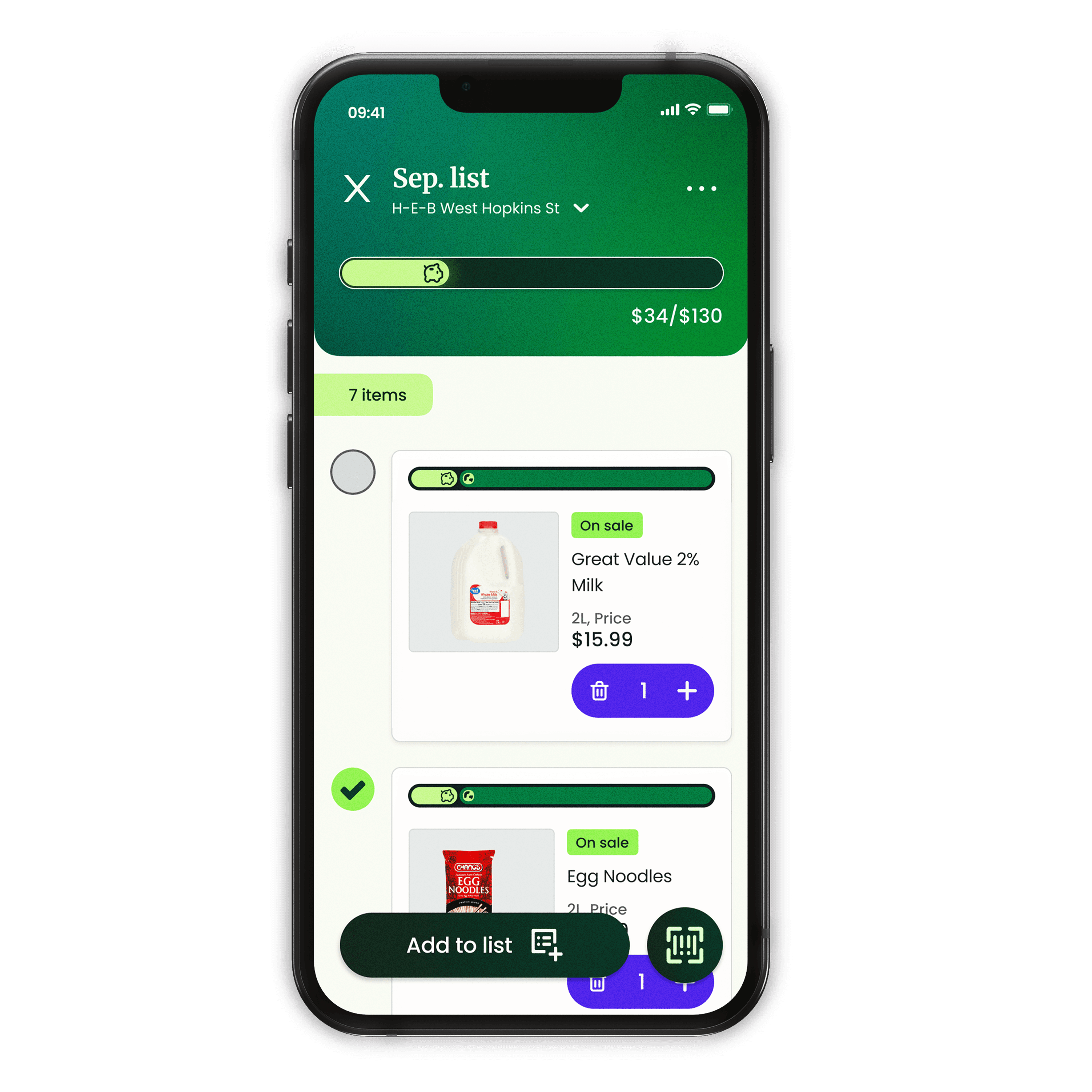
02: Smart Lists
Sustainable intentions collapse at the grocery store.
Users knew what they wanted to buy but had no way to evaluate options against cost and sustainability at the same time — so convenience won by default.
List building with automatic swap suggestions ranks items along a dynamic scale balancing budget and sustainability. There's no wrong pick, only a better one available to you right now.
85.1%
said personalized grocery suggestions would have the biggest impact on their choices.

03: Barcode Scanner
The hardest moment is a quick decision with no good options.
Convenience stops — gas stations, vending machines, unplanned bites — are where users feel the most guilt and have the fewest tools to help them.
The scanner compares any two products side by side across sustainability, nutrition, and cost in real time. The framing is always "better of the two," not pass or fail.
53.2%
selected real-time comparisons as a feature they'd want, validating the scanner as a core MVP feature rather than a secondary one.

Icons and illustrations

04: Personalized Insights
Without visible progress, people disengage.
40% of prior nutrition app users quit because the app lost relevance over time. Tracking without feedback isn't accountability — it's just logging.
The insights view visualizes the compounding impact of small choices over time across spending, sustainability, and nutrition quality. Progress is always framed as momentum, never as a deficit.

BUILD
Demos and pivots
To test how the scanner, list logic, and goal balancing would actually function, I used Figma's MCP integration with Cursor to build a working prototype in HTML, CSS, and JavaScript.
Reflection
Small choices compound. So does the right framing.
This was a school project, so there weren't results to measure at a production level. But the survey already signals where success would land: in reduced guilt, changed behavior, and the personalized features users said they wanted most.
The next step is usability testing to validate the swap logic, scanner comparison model, and dashboard framing. After that, building out the flows for V2 and V3 features with continued user testing to validate their priority and iterate as needed.
Outcome
72%
interest from users following initial demo.
85%
preference for personalized suggestions over other proposed features.
91.5%
carry some level of guilt about their food choices, and every design decision in this project was made in response to that number.
Next steps
01
Usability testing
validate the core interactions for the scanner and list building before expanding scope
02
Refine prototype
replace mock data with a stable API integration, cleaner UI, user testing
03
Build out V2 features
personalized recipes, pantry inventory, and community accountability
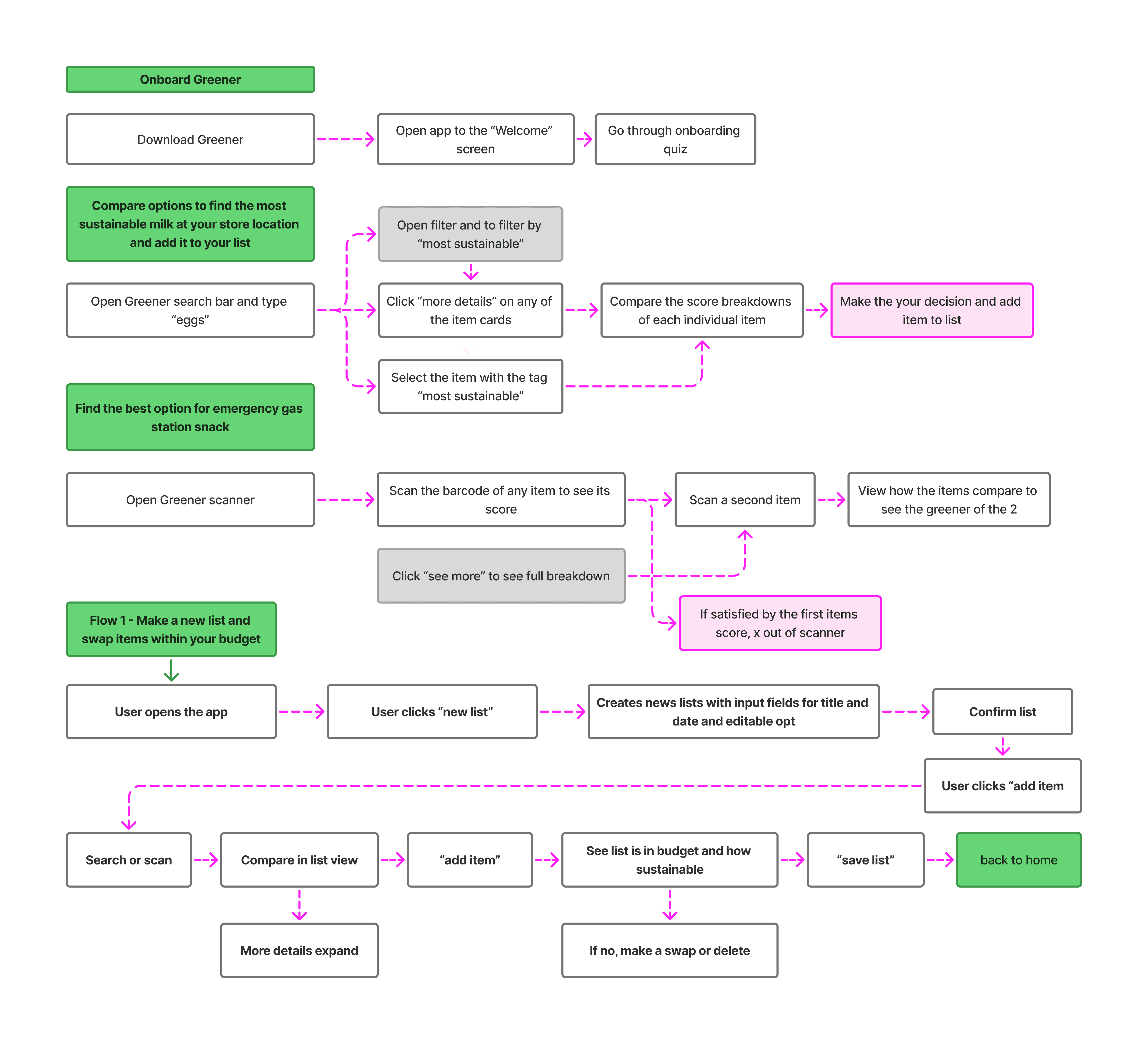
User Journey

App structure overview
Home Dashboard
Impact overview, personal tips and insights, list creation and history.
Pantry
Recipe browser and suggestions, pantry/ingredient inventory.
Community
Goal sharing and accountability, "low energy" mode.


Design
The first iteration of UI design to communicate the tone and function of the app.
The user first completes an onboarding quiz. This collects information about dietary preferences, monthly budget, and sustainability goals to power the personalization engine.
API implementation
I needed a dataset with nutrition info and some kind of sustainability metric. This led me to try openfoodfacts free API. Unfortunately, the dataset was too large and kept lagging, or failing to load entirely.
I scraped 50 items across broad categories to demo the functionality, planning to fix it later.
Pivot!
As it often goes, my code broke the morning of my presentation and search stopped rendering results entirely. I pivoted and walked through the flow using a pre-populated list instead, still showing every state and feature, just without live search.